Thursday, March 19, 2009

Time to claim success on electronic sketching of UIs?


In Las Vegas this week (March 18th), Microsoft demoed Microsoft Expression Blend 3 with SketchFlow. SketchFlow is a new tool that appears to be a commercial strength version of our previous research tools in this space:
  • SILK -- for sketching, storyboarding, and prototyping GUIs
  • Denim -- for sketching, storyboarding, and prototyping Web sites (w/ lots more in terms of functionality and testing than was possible in SILK)
  • K-Sketch - informal prototyping of animations

Much of the functionality of these three research tools has been embedded in a full strength web development system (Expression Blend 3). The image above shows the UI, but doesn't really capture it (you need to watch the video below).

Watch this video of the demo (go to about 2/3 of the way in If you go too far in and they are already sketching, just back up a bit. The video is quite long.):
http://live.visitmix.com/
(click on Day 1 Keynote)

More info on it here:
http://electricbeach.org/?p=145

The talks use the term "informal" all over the place. Clearly our "informal user interfaces" work has had impact on industry. I know this often takes many years (we first showed SILK in 1995!). But I want to thank Brad Myers (my PhD advisor) and all of the students, staff, and postdocs that have worked on this project (especially Jimmy, Jason, Mark, Richard, and Yang). You should all be quite happy to see this come to fruition. It sometimes takes many years to see impact and many other researchers never see it.

What do you guys think? Are we done? What don't they do?

PS Watch the Buxton intro at the beginning to see a lot of the motivation. I wonder if they will claim to never have seen our work and were instead motivated by Buxton's recent book?

Thursday, February 12, 2009

Human Computer Interaction Consortium (HCIC) 2009

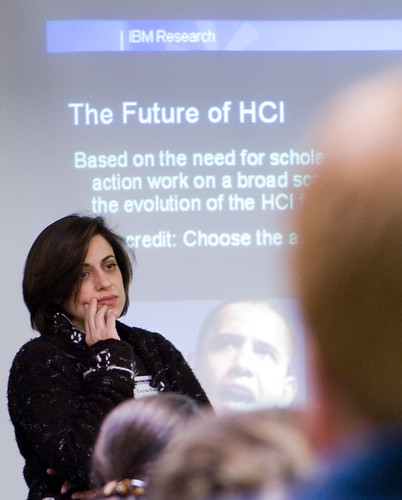
I went to the HCIC '09 Workshop in Fraser Colorado last week. It was a really great experience. UW's dub institute was recently admitted to this member only organization and the keys to this workshop are the small size (~75 attendees), top researchers attending (about half are top/senior folks in the field and the other half are the top graduate students that their departments have chosen to send), and the sessions are 90 minutes to cover ONE paper (yes one! -- see Leysia Palen of the U. Colorado ponder The Future of HCI at left). It also includes a lot of time for informal discussion while walking, taking a break, or skiing. I hadn't been since graduate school and forgot how great a venue it is. I had great chats with lots of folks, including my own former PhD advisor (Brad Myers --on left below).

Part of the excitement of the meeting for me was to see so many of my former graduate students taking an active part in the organization (Scott Klemmer), the talks (Jason Hong), and the discussion (Mark Newman, Jeff Heer, Scott, and Jason). It was also great to see one of my current students (Jon Froehlich) take it all in and see how he might be just like these former students soon. I felt like a proud father seeing his son ski down a hill for the 1st time (which I did indeed experience with both of my sons in a major way on this trip -- nothing like a 3 year old skiing and a 7 year old challenging himself on intermediate runs!)

It was great to present my talk on Activity Based Design to this group of strong researchers. I doubt the work would have had that good of an audience had I presented at CHI or another major conference due to the parallel tracks.

Some comments and questions about HCIC. If you made the workshop more open to others, then you'd lose some of the keys to the size. If you added more talks so that more of the folks there could participate, you would lose these great 90 minute sessions that you simply don't get at conferences. I guess we shouldn't muck with it. Any ideas?

Is Kindle 2 the eBook that finally makes it?

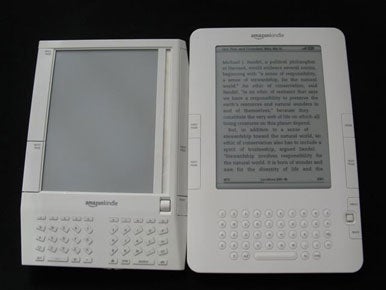
The Amazon Kindle has done well but the number sold is still small. Amazon has come out with a new version of the Kindle. It finally seems to be the right size with respect to thickness (1/3 inch), though I'm still hoping for better mark-up with a pen (ala I wrote about with respect to the Plastic Logic device in September '08) and more of the device dedicated to the display. I hate all the buttons on the Kindle -- see the old and new Kindles on left and right, respectively, of the image. What do you folks think?